By Ethan Brooks
Updated November 2026
Choosing a concentrated solar thermal plant reference is harder than it looks, because the field spans collector optics, heat transfer fluids, thermal storage and grid-scale power cycles. This list compares five titles based on their listed scope, the depth of technical coverage, and the patterns owners and readers tend to report. The selection criteria are topic fit, level of detail, how current the material appears, and how well each title matches a specific reader’s job.
Best overall: Concentrated Solar Thermal Plant for Future Fuels Production – View on Amazon
Best for system engineering: Solar Thermal Power Plant System Engineering – View on Amazon
Best for combined-cycle design: Power Plant Design with Two Concentrated Solar Thermal Power Sources – View on Amazon
Best for heat-related field support: American Plant Exchange 96-Hour Heat Warmer – View on Amazon
Best for performance modeling: SAM-Based Performance Modeling of a 50 MWe Solar Thermal Power Plant – View on Amazon
Our Top Picks
| Product | Best for | Key feature |
|---|---|---|
| Concentrated Solar Thermal Plant for Future Fuels Production | Broad overview | Fuels-oriented plant context |
| Solar Thermal Power Plant System Engineering | Engineers designing systems | Collector and storage integration |
| Power Plant Design with Two Concentrated Solar Thermal Power Sources | Combined-cycle planning | Dual-source plant layouts |
| American Plant Exchange 96-Hour Heat Warmer | Field heat protection | Long-duration heat pack |
| SAM-Based Performance Modeling of a 50 MWe Solar Thermal Power Plant | Performance modeling students | Simulation-based 50 MWe case |
Concentrated Solar Thermal Plant for Future Fuels Production

Concentrated Solar Thermal Plant for Future Fuels Production
Best for: Readers who want a broad orientation to how concentrated solar heat can feed fuel production as well as electricity.
This title suits students and planners who need the big picture before going into component-level detail.
Pros
- Frames the plant as a heat source for more than power generation.
- Useful starting point for non-specialists.
Cons
- Less depth on individual component design.
Solar Thermal Power Plant System Engineering

SOLAR THERMAL POWER PLANT SYSTEM ENGINEERING: Collector design heat transfer optimization and storage integration
Best for: Engineers who need to size collectors, optimize heat transfer and plan thermal storage integration.
A strong fit for design engineers working through the full heat-to-power chain.
Pros
- Covers collector design and heat transfer together.
- Addresses storage integration, which many overviews skip.
Cons
- Assumes a working knowledge of thermodynamics.
Power Plant Design with Two Concentrated Solar Thermal Power Sources

Power plant design with two concentrated solar thermal power sources: Power plant design with a combined cycle and double concentrated solar thermal power sources
Best for: Planners evaluating combined-cycle layouts that draw on two concentrated solar thermal power sources.
Best suited to advanced students and engineers comparing plant configurations. A related read: Top 6 Concentrated Solar Thermal Energy Books Compared (2026).
Pros
- Focused on combined-cycle and dual-source design.
- Specific enough to support a layout comparison.
Cons
- Narrow scope beyond the dual-source configuration.
American Plant Exchange 96-Hour Heat Warmer

American Plant Exchange 96-Hour Heat Warmer – Long-Lasting Shipping Heat Pack for Live Plants, Cold Weather Protection, Reliable 4-Day Temperature Control
Best for: Protecting heat-sensitive items during cold transport and holding temperature for long periods.
This is a shipping heat pack rather than a technical reference, so it fits a different need entirely.
Pros
- Long-duration heat output stated by the manufacturer.
- Simple to use with no setup.
Cons
- Not relevant to plant design or engineering study.
SAM-Based Performance Modeling of a 50 MWe Solar Thermal Power Plant
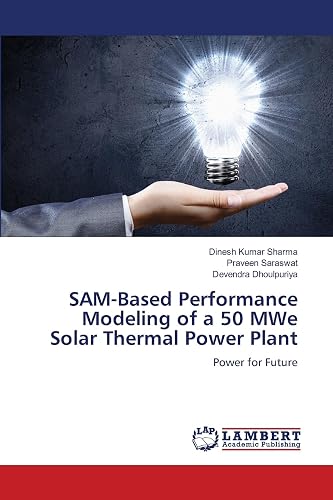
SAM-Based Performance Modeling of a 50 MWe Solar Thermal Power Plant: Power for Future
Best for: Students and analysts who want to model output of a utility-scale plant using simulation software.
Useful for anyone learning to predict annual energy yield before building.
Pros
- Works through a concrete 50 MWe case study.
- Teaches simulation workflow alongside plant physics.
Cons
- Requires familiarity with modeling software.
Buying Guide
Match the Title to Your Role
Students usually need broad coverage, while working engineers need design depth. Decide which before comparing page counts.
Check the Scope of Components
Look for coverage of collectors, heat transfer fluid, storage and power cycle. A title that covers only one of these leaves gaps.
Look at Modeling Content
If you plan to estimate output, check whether the book includes worked examples or simulation steps.
Confirm Publication Currency
Plant technology changes, so check the edition year and whether examples reflect current designs.
Good picks for this: Solar Thermal Power Plant System Engineering and SAM-Based Performance Modeling of a 50 MWe Solar Thermal Power Plant
FAQ
What is a concentrated solar thermal plant?
It is a power facility that uses mirrors or lenses to focus sunlight onto a receiver, heating a fluid that drives a turbine or other heat engine.
Do I need engineering background to use these references?
Not for every title, but design-focused books assume knowledge of thermodynamics and heat transfer.
Are these references enough to build a plant?
No. They support study and planning, and a professional engineer should handle any real design or construction work.
Related reading
- What Is the Largest Thermal Solar Plant in the World? Key Facts
- What Is the Largest Solar Thermal Power Plant in India? Answer and Details
- What Is a Solar Thermal Plant Definition? Key Facts Explained
- Top 5 Concentrated Solar Thermal Power Books and References Compared (2026)
About Ethan Brooks
Ethan Brooks is part of our editorial team and reviews and edits our solar water heaters guides, checking product details against manufacturer specifications and owner feedback.