By Ethan Brooks
Updated November 2026
Solar power thermal generation covers the science of collecting sunlight as heat and turning that heat into electricity. Readers looking for solar power thermal generation references usually need one of three things: a foundational textbook, a focused research monograph, or a technical standards compilation. The selection criteria below weigh subject depth, the intended reader, and how current and specific each title is to thermal (rather than photovoltaic) generation.
Best overall: Solar Power Generation – View on Amazon
Best for research depth: Structural Optimization and Experimental Investigation of the Organic Rankine Cycle – View on Amazon
Best for receiver design: Solar Receivers for Thermal Power Generation – View on Amazon
Best for system integration: Optimization of Coordinated Thermal-Wind-Solar Power Generation – View on Amazon
Best for standards compliance: Compilation of National Standards for Solar Thermal Power Generation – View on Amazon
Best for specialized materials: Solar and Thermal Power Generation: Poly(2,2-Bithiophene)-based Organic Dipositives – View on Amazon
Our Top Picks
Quick Comparison
| Product | Best for | Key feature |
|---|---|---|
| Solar Power Generation | Broad introduction | General system overview |
| Organic Rankine Cycle for Solar Thermal Power Generation | Research depth | Experimental cycle analysis |
| Solar Receivers for Thermal Power Generation | Receiver design | Fundamentals plus advanced concepts |
| Coordinated Thermal-Wind-Solar Power Generation | System integration | Hybrid optimization methods |
| National Standards for Solar Thermal Power Generation | Standards compliance | Compiled national standards |
| Poly(2,2-Bithiophene)-based Organic Dipositives | Specialized materials | Organic device focus |
Solar Power Generation

Solar Power Generation
Best for: a broad introduction to solar power generation methods.
This suits students and early-career engineers who want an overview before specializing in thermal systems.
Pros
- Covers the main generation approaches in one volume
- Accessible structure for newcomers
Cons
- Less depth on thermal-cycle engineering
Structural Optimization and Experimental Investigation of the Organic Rankine Cycle for Solar Thermal Power Generation

Structural Optimization and Experimental Investigation of the Organic Rankine Cycle for Solar Thermal Power Generation (Springer Theses)
Best for: research depth on organic Rankine cycle power blocks.
Aimed at graduate students and researchers working on the power-conversion side of a solar thermal plant.
Pros
- Combines structural optimization with experimental results
- Focused on a single, well-defined cycle type
Cons
- Narrow scope outside the power block
Solar Receivers for Thermal Power Generation: Fundamentals and Advanced Concepts
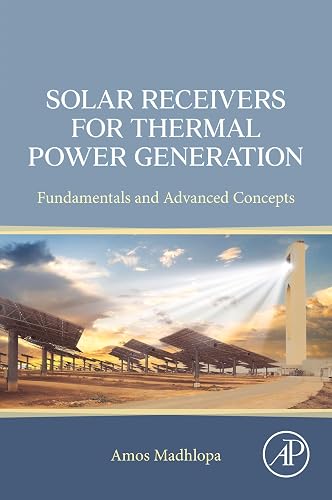
Solar Receivers for Thermal Power Generation: Fundamentals and Advanced Concepts
Best for: receiver design in concentrating systems.
Useful for engineers who need to understand how absorbers and receivers capture and transfer concentrated heat.
Pros
- Progresses from fundamentals to advanced concepts
- Directly relevant to receiver sizing decisions
Cons
- Assumes some heat-transfer background
Optimization of Coordinated Thermal-Wind-Solar Power Generation

OPTIMIZATION OF COORDINATED THERMAL-WIND-SOLAR POWER GENERATION
Best for: planning hybrid thermal, wind and solar supply.
Suited to power-systems planners and researchers modeling multi-source generation.
Pros
- Addresses coordination across several generation sources
- Optimization-focused approach
Cons
- Heavily mathematical; less practical for small installations
Compilation of National Standards for Solar Thermal Power Generation

Compilation of National Standards for Solar Thermal Power Generation(Chinese Edition)
Best for: checking requirements against national standards.
Helpful for engineers and compliance staff who need the written standards in one place. Confirm the edition is current before relying on it.
Pros
- Collects standards in a single reference
- Useful for specification and compliance work
Cons
- Chinese-language edition, which may limit use for some readers
Solar and Thermal Power Generation: Poly(2,2-Bithiophene)-based Organic Dipositives

Solar and Thermal Power Generation:: Poly(2,2-Bithiophene)-based Organic Dipositives
Best for: specialized organic materials research.
Intended for materials scientists exploring organic devices connected to solar and thermal energy conversion.
Pros
- Narrow, materials-focused scope
- Relevant to emerging device research
Cons
- Not a general guide to thermal plants
Buying Guide
Match the Book to Your Role
Students usually benefit from an overview, while design engineers need receiver and power-block detail. Researchers should look for experimental data and current methods.
Check the Scope
Some titles cover whole systems, while others focus on one component such as the receiver or cycle. A narrow title can be excellent but will not replace a general text.
Confirm Standards Editions
Standards change over time. Verify the edition year and issuing body before using any compiled standard for a design decision.
Consider Language and Format
Some references are published in languages other than English. Make sure you can read the edition you order.
Good picks for this: Solar Power Generation and Solar Receivers for Thermal Power Generation
FAQ
What is the difference between solar thermal and solar photovoltaic power generation?
Solar thermal generation collects sunlight as heat, usually with mirrors or receivers, and uses that heat to drive a steam or organic Rankine cycle turbine. Photovoltaic systems convert light directly into electricity using semiconductor cells. The books in this roundup focus on the thermal route, so they cover heat transfer, receivers, and power cycles rather than cell physics.
Do I need a strong engineering background to use these references?
Most of the titles assume undergraduate-level knowledge of thermodynamics, heat transfer, and fluid mechanics. Readers coming from a related field can usually follow the introductory chapters, but the research monographs and standards compilations are best suited to working engineers, researchers, or graduate students. If you are new to the subject, start with the broadest textbook and move to specialized titles later.
How current are the standards in a national standards compilation?
Standards are revised periodically, so a compilation can become outdated relatively quickly. Before relying on any specific requirement, check the publication date and confirm whether the cited standard has been superseded. Consulting the issuing standards body directly is the safest way to verify that a clause still applies.
Are these books useful for planning a commercial solar thermal plant?
They can support the early technical understanding behind a project, including receiver design, cycle selection, and system optimization. However, a real plant requires site-specific engineering, local permitting, and input from licensed professionals. Treat these references as background reading rather than as a substitute for project-specific design work.
Should I choose a book on thermal generation or one on solar energy in general?
Choose a thermal-focused title if your work involves concentrating collectors, receivers, or heat-driven turbines. A general solar energy book will give broader context but may cover photovoltaics in more depth than you need. Matching the title’s scope to your actual task saves time and avoids paying for material you will not use.
Is a newer edition always better than an older one?
For fast-moving topics like materials, controls, and standards, a more recent edition is generally preferable because it reflects current practice. For foundational physics and thermodynamics, an older edition can still be perfectly accurate. Check the table of contents and publication year to decide whether the updates matter for your purpose.
Conclusion
For a broad, foundational introduction to solar power thermal generation, the general textbook is the most sensible starting point. Readers who need depth on a specific component or cycle should look to the focused research and receiver titles, while engineers working on compliance or specifications will benefit most from the standards compilation.
Match your choice to your role: students and newcomers should prioritize clarity and scope, while practicing engineers and researchers should prioritize specificity and currency. Confirming the edition, language, and format before buying will help ensure the book fits your work.
Related reading
- Top 6 Solar Thermal Power Generation System Options Compared for 2026
- Solar Thermal Power Generation Technologies: 4 Main Types Explained (2026)
- Solar Thermal Power Generation Diagram: How to Read and Build One
- What Is the Largest Solar Thermal Power Plant in India? Answer and Details
About Ethan Brooks
Ethan Brooks is part of our editorial team and reviews and edits our solar water heaters guides, checking product details against manufacturer specifications and owner feedback.