By Audrey Hayes
Updated November 2026
Choosing an evacuated tube solar thermal system comes down to tank size, how many people you need to supply, the mounting space you have, and how much of your daily hot water you want the sun to cover. This roundup compares three packaged options from the evacuated tube category, judged on tank capacity, collector design, mounting and freeze resistance, and the patterns owners tend to describe in their feedback. Each pick is matched to a specific household or site need so you can see quickly which one fits.
Best overall: 200 Liter Water Heater Active Split System – View on Amazon
Best for larger households: 300 Liter Water Heater Active Split System – View on Amazon
Best for pools and seasonal heating: Industrial Grade Solar Pool Heater DIY Kit – View on Amazon
Our Top Picks
Quick Comparison
| Product | Best for | Key feature |
|---|---|---|
| 200 Liter Water Heater Active Split System | Small to mid-sized households | Split system with single coil tank and evacuated vacuum tubes |
| 300 Liter Water Heater Active Split System | Larger households with higher daily demand | Larger storage volume on the same split-system design |
| Industrial Grade Solar Pool Heater DIY Kit | Pool heating and seasonal use | Strapless mounting system and freeze resistance rated for high wind |
200 Liter Water Heater Active Split System Single Coil Tank 45 Deg Frame Evacuated Vacuum Tubes Hot SRCC Certified
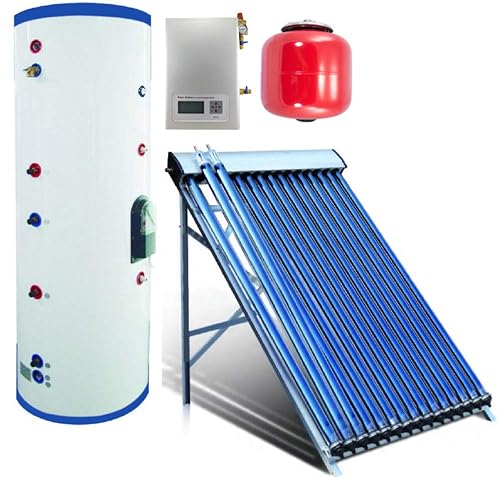
200 Liter Water Heater Active Split System Single Coil Tank 45 Deg Frame Evacuated Vacuum Tubes Hot SRCC Certified A related read: Solar Panel Specifications for DIY Systems: What Each Number Means.
Best for: Small to mid-sized households looking for a straightforward evacuated tube solar thermal system
This unit suits a household of one to three people, or a small home where hot water use is moderate and roof or yard space is limited. The active split system keeps the storage tank separate from the collector, which gives you flexibility on placement.
Key specs
- Storage capacity: 200 liters
- Tank type: single coil
- Frame angle: 45 degrees
- Collector: evacuated vacuum tubes
- Certification: SRCC (per listing)
Pros
- Split design lets you place the tank indoors or in a sheltered spot.
- Evacuated tubes perform better than flat plates in cool or overcast conditions, according to most manufacturer specifications.
- Single coil tank keeps the plumbing layout simple.
Cons
- Capacity may run short for larger families on heavy-use days.
- An active split system needs a pump and controller, which adds components to maintain.
Bottom line: A sensible first choice for a small household that wants solar-preheated hot water with a clear, manageable installation.
300 Liter Water Heater Active Split System Single Coil Tank 45 Deg Frame Evacuated Vacuum Tubes Hot SRCC Certified
300 Liter Water Heater Active Split System Single Coil Tank 45 Deg Frame Evacuated Vacuum Tubes Hot SRCC Certified
Best for: Larger households with higher daily hot water demand
If you run multiple showers a day, a dishwasher and a washing machine, the extra storage in this model gives you more buffer before the backup heater has to run. It uses the same split-system approach as the 200-liter version, so the installation logic carries over.
Key specs
- Storage capacity: 300 liters
- Tank type: single coil
- Frame angle: 45 degrees
- Collector: evacuated vacuum tubes
- Certification: SRCC (per listing)
Pros
- Larger storage holds more heat for high-demand days.
- Same split-system layout as the smaller model, so the components are familiar.
- Evacuated tubes retain heat well in lower outdoor temperatures.
Cons
- The larger tank is heavier and needs a sturdier mounting location.
- It requires more floor or wall space indoors than the 200-liter model.
Bottom line: Pick this if your household consistently uses more hot water than a 200-liter tank can cover between sunny periods.
Industrial Grade Solar Pool Heater DIY Kit – Superior High-Wind Strapless Mounting System & Maximum Freeze Resistance (2-4’x10.5′ / 84 Square Feet)

Industrial Grade Solar Pool Heater DIY Kit – Superior High-Wind Strapless Mounting System & Maximum Freeze Resistance (2-4'x10.5' / 84 Square Feet)
Best for: Pool heating and seasonal use in exposed locations
This kit is designed for heating a swimming pool rather than domestic hot water, so it is a different application from the two tank systems above. It fits homeowners who want to extend the swimming season and have a suitable open, sunny area for a ground or roof array.
Key specs
- Coverage: 2–4 panels at 10.5 ft, 84 square feet total (per listing)
- Mounting: strapless, rated for high wind (per listing)
- Freeze resistance: stated maximum by manufacturer
Pros
- Strapless mounting system is designed to handle high-wind sites.
- Freeze resistance suits climates with cold shoulder seasons.
- Scalable panel count fits a range of pool sizes.
Cons
- Not intended for domestic hot water, so it does not replace a water heater.
- DIY assembly requires careful attention to plumbing connections and flow balance.
Bottom line: The right choice for pool owners who want solar heat in an exposed setting, not for household showers.
Buying Guide
Tank Capacity and Household Demand
Estimate daily hot water use per person before comparing tank sizes. Manufacturers typically recommend sizing storage so the tank can cover most of a typical day’s draw. Undersizing means more reliance on the backup heater, while oversizing adds heat loss and cost to the system.
Good picks for this: 200 Liter Water Heater Active Split System, 300 Liter Water Heater Active Split System
Collector Type
Evacuated tubes use a vacuum layer to reduce heat loss, which is why they are often specified for colder or cloudier conditions. Flat plate collectors can be cheaper to build but generally lose more heat in winter. The evacuated tube design is the main reason the first two picks are suited to cooler climates.
Good picks for this: 200 Liter Water Heater Active Split System, 300 Liter Water Heater Active Split System
Split vs. Integrated Layout
A split system places the tank apart from the collector and uses a pump to circulate fluid. This gives you more placement options but adds a controller and pump to maintain. Integrated designs are simpler but limit where the tank can go.
Good picks for this: 200 Liter Water Heater Active Split System, 300 Liter Water Heater Active Split System
Mounting and Wind Resistance
Check the mounting method against the wind exposure at your site. Roof-mounted and ground-mounted arrays face different loads, and a strapless system may suit exposed locations better than strap-down designs. Confirm that your roof structure can carry the added weight.
Good picks for this: Industrial Grade Solar Pool Heater DIY Kit
Freeze Protection
In climates with hard freezes, look for documented freeze resistance and understand how the system protects its fluid and plumbing in cold snaps. Winter operation is a common concern, and the guide on keeping systems working in cold weather covers the main strategies.
Good picks for this: Industrial Grade Solar Pool Heater DIY Kit, 200 Liter Water Heater Active Split System
Use Case: Domestic Water or Pool
Decide first whether you need domestic hot water or pool heating, because the systems are designed for different loads. A pool heater does not provide potable hot water, and a domestic tank system is not sized for a pool.
Good picks for this: Industrial Grade Solar Pool Heater DIY Kit, 300 Liter Water Heater Active Split System
Durability and Maintenance
Check how the tubes, frame and tank are protected against corrosion and UV exposure. Plan for periodic inspection of seals, pump operation and fluid condition in active systems. Owners often report that maintenance is easiest when the components are accessible at installation.
Good picks for this: 300 Liter Water Heater Active Split System, 200 Liter Water Heater Active Split System
FAQ
What is an evacuated tube solar thermal system?
It is a solar heating system that uses glass tubes with a vacuum layer around an absorber to capture heat and transfer it to water or a heat-transfer fluid. The vacuum reduces heat loss, which helps performance in cool weather.
How much hot water can an evacuated tube system supply?
That depends on collector area, tank size, sunlight and household use. Manufacturers usually give a rough daily volume range for each model, and a backup heater is normally still needed for cloudy days and peak demand.
Do evacuated tube systems work in winter?
They generally perform better than flat plate collectors in cold conditions because of the vacuum insulation, but output drops with shorter days and lower sun angles. Freeze protection and proper drainage or fluid choice are essential in cold climates.
Is a split system better than an integrated one?
A split system offers more flexibility in tank placement and often suits sites where the collector and storage must be apart. Integrated systems are simpler to maintain but less adaptable. Neither is universally better; it depends on your roof and plumbing layout.
Can I use a pool heater kit for domestic hot water?
No. Pool heater kits are designed for lower-temperature pool water and are not built to provide potable hot water to a household. Use a domestic-rated system for showers and kitchen use.
Do I need a professional to install one?
Plumbing and electrical connections for pumps and controllers should follow local codes, and a licensed installer can confirm structural loads on the roof. Consult a qualified professional before installing, especially for roof-mounted systems.
Conclusion
For most small households, the 200 Liter Water Heater Active Split System is the most balanced starting point, offering an evacuated tube collector and split layout at a manageable size. If your daily hot water use is higher, the 300 Liter Water Heater Active Split System provides more storage on the same design. For pool owners in exposed, cold-season locations, the Industrial Grade Solar Pool Heater DIY Kit addresses a different need entirely. Match the pick to your load and your site rather than to the label alone.
Sources
- Federal guidance on solar water heating basics, system types and sizing considerations (energy.gov)
- Research resources on solar thermal performance and collector technology (nrel.gov)
- Workplace and rooftop safety guidance relevant to installing solar equipment (osha.gov)
Related reading
- Evacuated Tube Solar Thermal: How It Works and How to Choose One (2026)
- Evacuated Tube Solar Thermal Collector: 7 Steps to Build or Choose One
- 4 Best Solar Hot Water Evacuated Tube Systems (2026): Our Picks
- Top 7 Solar Thermal Energy Conversion System Options Worth Considering in 2026
- Top 6 Solar Thermal Power Generation System Options Compared for 2026
- Top 5 Solar Thermal Storage Tanks for Home Hot Water Systems
About Audrey Hayes
Audrey Hayes is part of our editorial team and reviews and edits our solar water heaters guides, checking product details against manufacturer specifications and owner feedback.